


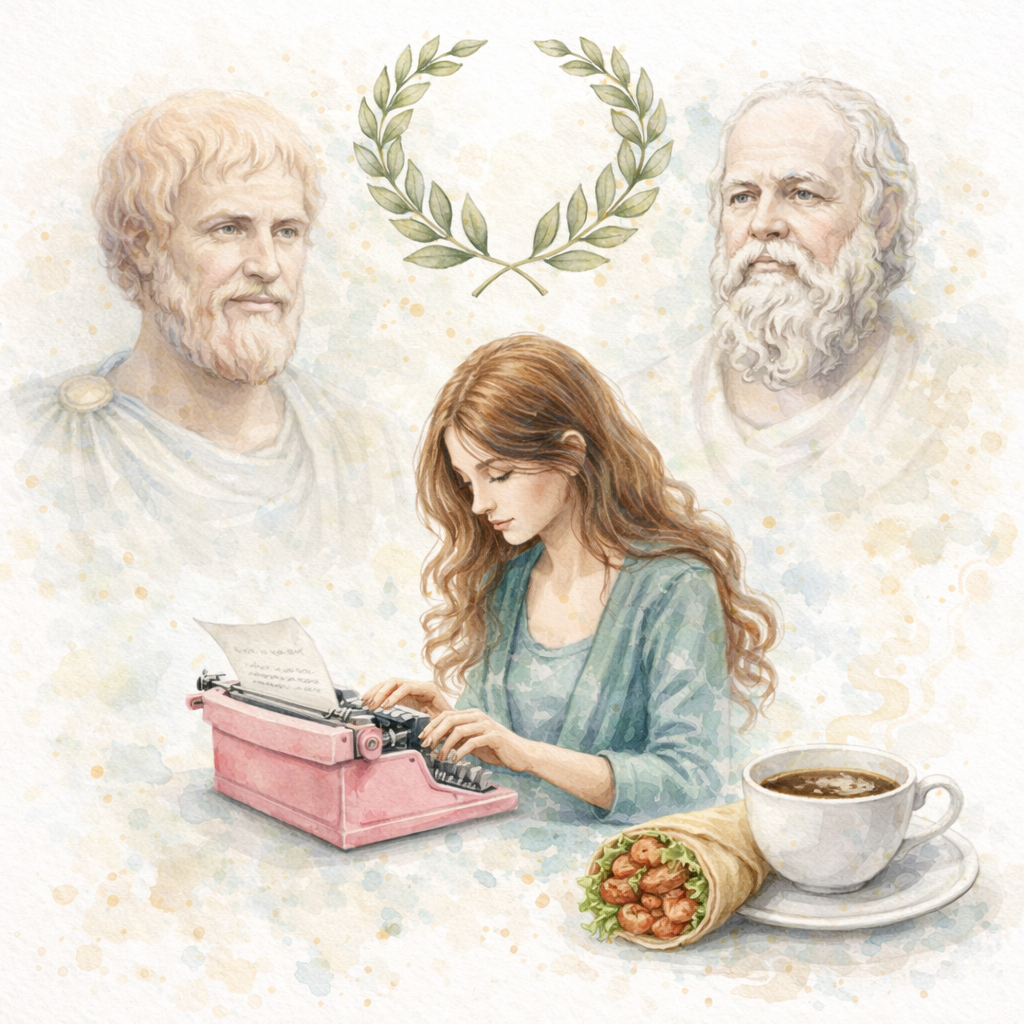
The wise woman sets out on a journey.
But what does it mean to travel wisely?
Fast, by airplane? Or on two feet with a walking stick? With a high credit card limit, or trusting in the generosity of strangers? With the guided tour group “Cultural Nomads”, or alone in the familiar company of one’s own self, searching for self-discovery?
The wise do not even begin with such questions. The how is never the beginning of an answer worthy of them.
Wisdom follows laws similar to those of magic. There too, the how only comes third. First comes the point of departure: a desire, a goal, a stance.
In my case: Istanbul.
With the desire to write — and through writing, to provoke, to make people think and argue. In this text, about what wisdom is.
And so begins her journey toward the completed text. The scent of kebab fills the air — distraction. The wise woman aims for the first step of magic.
What do I say yes to?
What do I say no to?
Yes, I want to write about wisdom. The delicious smell of kebab and the charming waiter’s smile must, in this case, be met with a clear no. Most people do not fail because of yes, but because of the absence of no. Anyone can affirm a goal — only those who consistently deny what distracts them from the path keep the way clear. Nine compliments and one criticism: it is the criticism that remains. No weighs heavier than yes. It separates clarity from chaos. To ignore this would be to wage war against the laws of the universe — and so far, everyone has lost that war.
Horror vacui.
Faced with the fear of emptiness, the terror of the blank page, I sit in a café. Fear, too, demands a no. But not through suppression — through transformation. Whoever merely represses underestimates the backlash. Whoever uses fear transforms emptiness into momentum. Otherwise, within minutes, the white screen fills with a chaotic swarm-text bearing a Socrates quote as its title, dedicated to an audience that prides itself on being culturally and philosophically educated. Beneath it lies an unspoken desire for recognition, disguised beneath the carefully rehearsed performance known as Swiss modesty. Wisdom reduced to intellectual performance — pure mental masturbation. Wisdom here means: no to distraction.
At the next table, I overhear an argument drifting from inclusion to Julius Caesar to the death of John Lennon. Material for provocative writing on wisdom? I listen in.
“Divide et impera — divide and rule. Caesar was coherent! Unlike many of these New Agers with sociology minors writing ‘Inclusion’ across their vintage flannel shirts. Some animals are more equal than others! The very act of naming inclusion already assumes division. But dividir is bad and Caesar evil? ‘All you need is love,’ sang John Lennon — and he died with a bullet in his chest!”
The speaker calls for coherence. Words that do not align with actions are worthless. Without coherence between point of departure, word, and action, there is no magic — and no wisdom.
Aristotle called wisdom “knowledge of principles and causes.” I call them principles of magic. The wise journey begins at the point of departure, gains direction through yes, and clarity through no.
And here I sit, poor fool,
no wiser than before.
And yet, a little wiser.